-->
LATEST HEADLINES
66th REPUBLIC DAY WISHES TO ALL INDIANSZizix Tutorials
LATEST POSTS TIME OF NOW
Showing posts with label DEFORESTATION. Show all posts

Global consumption an increasingly significant driver of tropical deforestation

The EU and China are the largest importers of carbon dioxide emissions linked to deforestation for the production of beef, soy, palm oil and timber between 2000-2009. The researchers have focused on seven countries (Argentina, Bolivia, Brazil, Paraguay, Indonesia, Malaysia and Papua New Guinea), all of which are major exporters of goods that contribute to deforestation. Credit: Center for Global Development
International trade with agricultural and wood products is an increasingly important driver of tropical deforestation. More than a third of recent deforestation can be tied to production of beef, soy, palm oil and timber. "The trend is clear, the drivers of deforestation have been globalized and commercialized," says assistant professor Martin Persson, Chalmers University of Technology.

In a report commissioned by US think-tank Center for Global Development (CGD) Martin Persson and colleagues in Linköping, Sweden, and Vienna, Austria, have investigated to which extent international trade in agricultural and silvicultural products drives deforestation in seven case countries: Argentina, Bolivia, Brazil, Paraguay, Indonesia, Malaysia and Papua New Guinea.

"From having been caused mainly by smallholders and production for local markets, an increasing share of deforestation today is driven by large-scale agricultural production for international markets. More than a third of global deforestation can be tied to rising production of beef, soy, palm oil and wood products," says Martin Persson.

"If we exclude Brazilian beef production, which is mainly destined for domestic markets, more than half of deforestation in our case countries is driven by international demand."

The research group has also analyzed the magnitude of the associated carbon dioxide emissions embodied in these trade flows. In total 1.7 billion tons of carbon dioxide emissions can be linked to the production of the analyzed commodities, with one third being embodied in commodity exports. The biggest recipients of these embodied carbon emissions are China and the EU. By elucidating the links between consumption and environmental impacts, the aim is to identify more effective measures to address tropical forest loss by targeting key commodities and countries.

"Another key trend is that more and more corporations have pledged to rid their supply chains from deforestation. Pushed by environmental organizations and seeing the risks of being associated with environmental destruction, companies like Unilever and McDonalds are pressuring their suppliers to stop expanding production on forest land," says Martin Persson.

It is no longer enough to just focus on the countries where deforestation happens and the potential policy measures available there, he adds.

"Today both public and private consumers, be it individuals or corporations, have the possibility to contribute to the protection of tropical forests by holding suppliers accountable for the environmental impacts of their production," Martin Persson concludes.

Source: Chalmers University of Technology
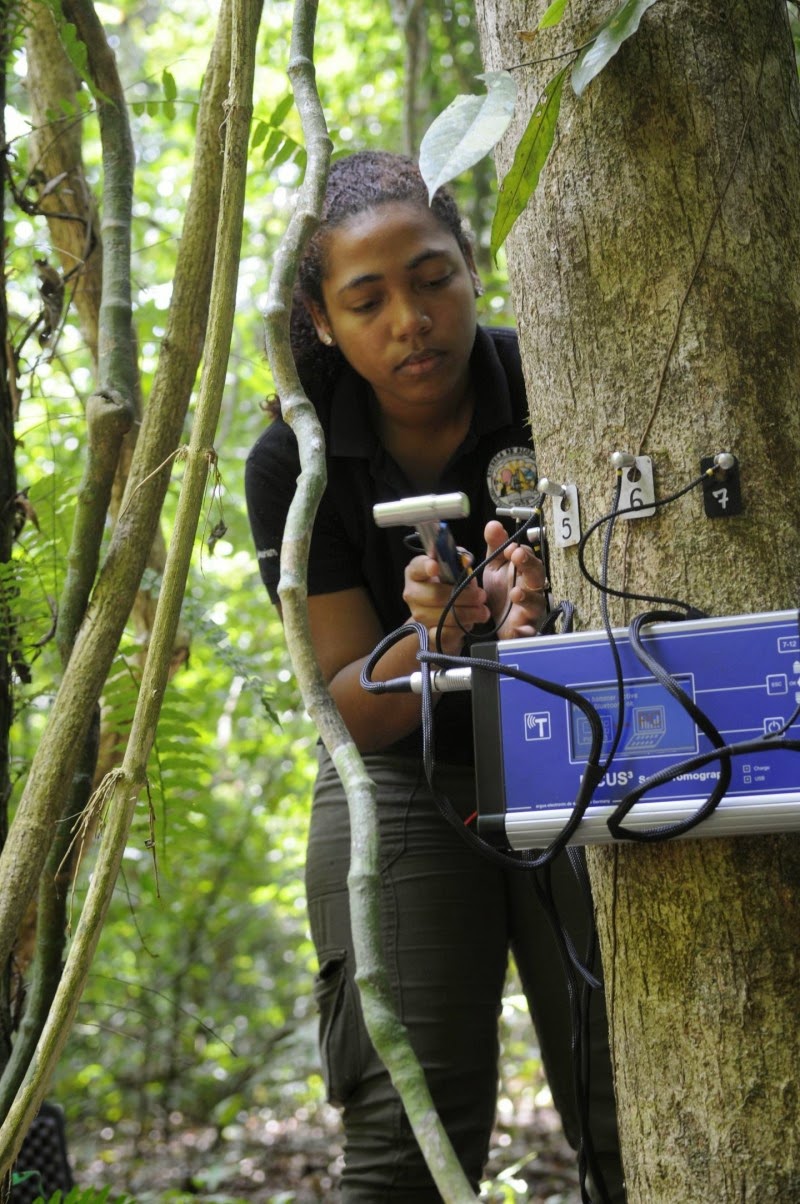
If trees could talk: Forest research network reveals global change effects

In addition to identifying, mapping, measuring and monitoring trees in the CTFS-ForestGEO study plots, researchers describe the relatedness of trees, track flower and seed production, collect insects, survey mammals, quantify carbon stocks and flows within the ecosystem, take soil samples and measure climate variables like rainfall and temperature. The thorough study of these plots provides insights into not only how forests are changing but also why. Credit: Beth King, STRI
Permafrost thaw drives forest loss in Canada, while drought has killed trees in Panama, southern India and Borneo. In the U.S., in Virginia, over-abundant deer eat trees before they reach maturity, while nitrogen pollution has changed soil chemistry in Canada and Panama. Continents apart, these changes have all been documented by the Smithsonian-led Center for Tropical Forest Science-Forest Global Earth Observatory, CTFS-ForestGEO, which released a new report revealing how forests are changing worldwide.

"With 107 collaborators we've published a major overview of what 59 forests in 24 countries, where we monitor nearly 6 million trees teach us about forest responses to global change," said Kristina Anderson-Teixeira, first author of the report and CTFS-ForestGEO and ecosystem ecologist based at the Smithsonian Conservation Biology Institute.

Many of the changes occurring in forests worldwide are attributable to human impacts on climate, atmospheric chemistry, land use and animal populations that are so pervasive as to warrant classification of a new geologic period in Earth's history -- the Anthropocene, the Age of Humans.

Measuring and understanding the effects of all these changes -- collectively termed "global change" -- are easier said than done. Some of the best information about these global-scale changes comes from CTFS-ForestGEO, the only network of standardized forest-monitoring sites that span the globe.

Since the censuses began at the first site on Barro Colorado Island in Panama in 1981, atmospheric carbon dioxide has increased by 16 percent. The forest sites in the network have warmed by an average of over 1 degree F (0.6 degree C) and experienced up to 30 percent changes in precipitation. Landscapes around protected sites experience deforestation.
The plot network now includes forests from Brazil to northern Canada, from Gabon to England and from Papua New Guinea to China.

In addition to identifying, mapping, measuring and monitoring trees, researchers describe the relatedness of trees, track flower and seed production, collect insects, survey mammals, quantify carbon stocks and flows within the ecosystem, take soil samples and measure climate variables like rainfall and temperature. The thorough study of these plots provides insights into not only how forests are changing but also why.

Climate change scenarios predict that most of these sites will face warmer and often drier conditions in the future -- some experiencing novel climates with no modern analogs. Forests are changing more rapidly than expected by chance alone, and shifts in species composition have been associated with environmental change. Biomass increased at many tropical sites across the network.

"It is incredibly rewarding to work with a team of forest scientists from 78 research institutions around the world, including four Smithsonian units" Anderson-Teixeira said. "CTFS-ForestGEO is a pioneer in the kind of collaborative effort it takes to understand how forests worldwide are changing."

"We look forward to using the CTFS-ForestGEO network to continue to understand how and why forests respond to change, and what this means for the climate, biodiversity conservation and human well-being," said Stuart Davies, network director.

Source: Smithsonian Tropical Research Institute

Colorado's Front Range fire severity not much different than past

A new study indicates present-day forest fires on Colorado's Front Range are not significantly more intense than historical fires. Credit: Glenn Asakawa, University of Colorado
The perception that Colorado's Front Range wildfires are becoming increasingly severe does not hold much water scientifically, according to a massive new study led by the University of Colorado Boulder and Humboldt State University in Arcata, Calif.

The study authors, who looked at 1.3 million acres of ponderosa pine and mixed conifer forest from Teller County west of Colorado Springs through Larimer County west and north of Fort Collins, reconstructed the timing and severity of past fires using fire-scarred trees and tree-ring data going back to the 1600s. Only 16 percent of the study area showed a shift from historically low-severity fires to severe, potential crown fires that can jump from treetop to treetop.

The idea that modern fires are larger and more severe as a result of fire suppression that allowed forest fuels to build up in the past century is still prevalent among some, said CU-Boulder geography Professor Thomas Veblen, a study co-author. "The key point here is that modern fires in these Front Range forests are not radically different from the fire severity of the region prior to any effects of fire suppression," he said.

A paper on the subject was published Sept. 24 in the journal PLOS ONE. The study was led by Associate Professor Rosemary Sherriff of Humboldt State University and involved Research Scientist Tania Schoennagel of CU-Boulder's Institute of Arctic and Alpine Research, CU-Boulder doctoral student Meredith Gartner and Associate Professor Rutherford Platt of Gettysburg College in Gettysburg, Pa.

The study was funded by the National Science Foundation.

"The common assumption is that fires are now more severe and are killing higher percentages of trees," said Sherriff, who completed her doctorate at CU-Boulder under Veblen in 2004. "Our results show that this is not the case on the Front Range except for the lowest elevation forests and woodlands."

One important new finding comes from a comparison of nine large fires that have occurred on the Front Range since 2000 -- including the 2002 Hayman Fire southwest of Denver, the 2010 Fourmile Canyon Fire west of Boulder and the 2012 High Park Fire west of Fort Collins -- with historic fire effects in the region.

"It's true that the Colorado Front Range has experienced a number of large fires recently," said Schoennagel. "While more area has burned recently compared to prior decades -- with more homes coming into the line of fire -- the severity of recent fires is not unprecedented when we look at fire records going back before the 1900s."
In addition, tree-ring evidence from the new study shows there were several years on the Front Range since the 1650s when there were very large, severe fires. The authors looked at more than 1,200 fire-scarred tree samples and nearly 8,000 samples of tree ages at 232 forest sample sites from Teller County to Larimer County.
The study is one of the largest of its kind ever undertaken in the western United States. The team was especially interested in fire records before about 1920, when effective fire suppression in the West began in earnest.

"In relatively dry ponderosa pine forests of the West, a common assumption is that fires were relatively frequent and of low severity, and not lethal to most large trees, prior to fuel build-up in the 20th century," said Veblen. "But our study results showed that about 70 percent of the forest study area experienced a combination of moderate and high-severity fires in which large percentages of the mature trees were killed."

Along the Front Range, especially at higher elevations, homeowners and fire managers should expect a number of high-severity fires unrelated to any kind of fire suppression and fuel build-up, said Schoennagel. "This matters because high-severity fires are dangerous to people, kill more trees and are trickier and more expensive to suppress."

"Severe fires are not new to most forests in this region," said Sherriff. "What is new is the expanded wildland-urban interface hazard to people and property and the high cost of suppressing fires for society."

In addition, a warming Colorado climate -- 2 degrees Fahrenheit since 1977 -- has become a wild card regarding future Front Range fires, according to the team. While fires are dependent on ignition sources and can be dramatically influenced by high winds, the team expects to see a substantial increase in Front Range fire activity in the low and mid-elevations in the coming years as temperatures continue to warm, a result of rising greenhouses gases in Earth's atmosphere.

Source: University of Colorado at Boulder

Deforestation threatens species richness in streams

In the catchment area of the river Yangtzekiang in Southern China deforestation takes place in order to gain arable land and build tea plantations. Credit: © M. Kuemmerlen
With a population of 1.3 billion, China is under immense pressure to convert suitable areas into arable land in order to ensure a continued food supply for its people. Accordingly, China is among the top countries in the world in terms of the extent and intensity of land use change. As shown in a new study by a team of scientists led by Dr. Britta Schmalz (Kiel University), in cooperation with Dr. Mathias Kuemmerlen, LOEWE Biodiversity and Climate Research Centre (BiK-F) and Dr. Sonja Jähnig, Leibniz-Institute for Freshwater Ecology and Inland Fisheries (IGB), deforestation may change the water surface runoff conditions, leading to a negative impact on the occurrence of microorganisms in rivers and streams.

Studies in a sub-basin of China's longest river
As part of this study, funded by the German Research Association (DFG), the team examined an area of about 1,700 square kilometers located in the Yangtzekiang River watershed, namely a tributary of the Poyang lake in Southern China. By using an ecohydrological model, it was possible to show how different land use types and intensity levels can influence the hydrological regime. The five scenarios that were studied encompassed three different deforestation and two afforestation scenarios. A medium deforestation rate, in which 53 percent of the forest is preserved (of the original 70 percent) and the remainder is used as agricultural land and for tea plantations, most closely approximates the ongoing expansion rate of agricultural areas in this Chinese region. This scenario was used to model the potential impact of these changes on the distribution of 72 species of invertebrates, known as stream macroinvertebrates.
Considerable range decreases for freshwater biota
Species rich stream reaches could become less frequent as a consequence of deforestation. Especially in areas where land use changes are expected to be most severe, is where insect larvae, snails, worms and leeches might become endangered. "As an example, we highlighted the distribution range of the stonefly Topoperla sp., based on a moderate rate of deforestation. As a result of the projected changes, its distribution range would decrease to a mere 15 percent of its current range," explains Mathias Kuemmerlen, BiK-F. Topoperla sp., as many other invertebrate microorganisms, is regarded as a water quality indicator. This leads to the conclusion that deforestation has a negative impact on the overall water quality.
Conversion to arable land changes the hydrological regime
In the present study, the cause for the decrease in species diversity is the changing hydrological regime resulting from the conversion of forest to arable land. According to the study, increasing deforestation causes, increased surface runoff, especially during the rainy season, which later flows on into streams and rivers. "In forested areas, surface water drains more slowly and in lower quantities; a significant percentage of the rain water is absorbed by the soil and by trees. Higher runoff rates may only be seen in floodplain forests, if at all. If forests are cut down and converted into fields, the surface runoff increases." says Kuemmerlen. If areas are afforested, the opposite trend occurs, allowing soils to store larger amounts of water again.
Land use change should be sustainable
The research team points out that the study's results offer a scientific basis for a sustainable landscape planning and management which takes into account the water cycle of the respective regions. The ultimate goal should be to use the limited resource "land" in a way that it ensures food security. . However, there must be room for the necessary adaptation measures in the face of global climate change. To certain degree this is supported by the preservation of forests in their role as runoff regulators and water reservoirs. Further modeling studies are being carried out elsewhere, also in Germany, in order to continue improving our knowledge on similar processes.
Source: Senckenberg Research Institute and Natural History Museum

Groundwater patches play important role in forest health, water quality

This is Kevin McGuire, associate director of the Virginia Water Resources Research Center. Credit: Virginia Tech
Even during summer dry spells, some isolated patches of soil in forested watersheds remain waterlogged.

These patches act as hot spots of microbial activity that remove nitrogen from groundwater and return it to the atmosphere, researchers from several institutions, including Virginia Tech, report in a leading scientific journal.

The discovery provides insight into the health of a forest. Nitrogen is an important nutrient for plant growth and productivity, but in streams, it can be a pollutant.

"The importance of these fragmented patches of saturated soil and their role in the fate of nitrogen in forested watersheds has been underappreciated until recently," said Kevin McGuire, an associate director of the Virginia Water Resources Research Center based in Virginia Tech's College of Natural Resources and Environment, co-author of the article to be published in the Proceedings of the National Academy of Sciences.

"We were able to determine the importance of denitrification in patches of shallow groundwater, which have largely been overlooked control points for nitrogen loss from temperate forested watersheds," McGuire said.

Most nitrogen is deposited by rain. Temperate forests receive much larger inputs of nitrogen from the atmosphere than they export to streams. Once nitrogen leaves the forest in streams, it can become a water pollutant.

"In some ecosystems, there have been long-term declines in stream water export of nitrogen when inputs have remained elevated," said co-author Christine Goodale, an associate professor of ecology and evolutionary biology at Cornell University.

"Understanding the fate of this nitrogen has been a challenge because denitrification -- a gaseous loss of nitrogen to the atmosphere -- is notoriously difficult to measure," said co-author Peter Groffman, an expert on denitrification at the Cary Institute of Ecosystem Studies.

Denitrification removes nitrogen from water and can therefore improve water quality in downstream lakes and estuaries.

However, nitrogen is also an important nutrient for plant growth in the forest so removals of nitrogen by natural processes can reduce the productivity of the forest.
The research, led by Sarah Wexler while she was a postdoctoral associate in hydrology and stable isotope geochemistry at Cornell University, took place in the Hubbard Brook Experimental Forest in the White Mountains of New Hampshire, where the atmosphere annually deposits five to seven pounds of nitrogen per acre.

The Hubbard Brook Experimental Forest is part of the National Science Foundation's Long Term Ecological Research Network.

McGuire, also an associate professor of hydrology in the Department of Forest Resources and Environmental Conservation, led another National Science Foundation-funded project at the site, which developed an organizing framework to describe and map variations of soil in the watershed that explain shallow groundwater occurrence and frequency.
Groundwater wells from this earlier study were used in the new research to monitor soils that may have had the right conditions to function as hot spots for denitrification.

At sites throughout the forest, the research team measured the presence of nitrate, a form of nitrogen that is highly mobile and reactive in the environment, determined whether the nitrate is a result of atmospheric deposition or microbial conversion, and discovered the nitrogen loss to the atmosphere.

"We were able to differentiate sources of nitrate and show that some of the nitrate was lost to the atmosphere by looking at nitrate at the atomic level, that is, at the isotopic composition of the nitrogen and oxygen in nitrate," said Wexler, who is now at the School of Environmental Sciences at the University of East Anglia in the United Kingdom. "The isotopic composition of nitrate provides a natural way to directly track the details of nitrogen cycling."

McGurie said, "Some work remains to be done, but the aim is to be able to develop a better sense of where and how nitrogen is processed in the environment and be in a position to predict how changes in climate, for example warmer and wetter conditions, affect nitrogen cycling and water quality in forested ecosystems."

SourceVirginia Tech

The Loss of biodiversity limits toxin degradation

You might not think of microbes when you consider biodiversity, but it turns out that even a moderate loss of less than 5% of soil microbes may compromise some key ecosystem functions and could lead to lower degradation of toxins in the environment.

Research published today in the SfAM journal, Environmental Microbiology, reports that without a rich diversity of soil bacteria, specialized functions such as the removal of pesticide residues are not as effective.

Dr Brajesh Singh of the University of Western Sydney led the work, he said "If the ability of the ecosystem to remove toxins from the environment is reduced, there will be higher toxicity risks in the environment and for non-target organisms, including humans, from agricultural chemicals. It is likely that these contaminants will remain at higher levels in surface and underground water, as well. It is vital to gain a better understanding of the extent to which soil bacteria are involved in the removal of contaminants."

The reasons for, and extent of, the decline in microbial diversity in agricultural soils is likely to be complex. The team has looked specifically at long-term heavy metal pollution where metals such as cadmium, zinc, and copper build up in the environment, usually as a result of industrial use. Another source is from digested sewage sludge, which is spread in agriculture fields to supply nutrients to crops and improve soil fertility; the sludge has historically contained some heavy metals, which can become concentrated in the soil.

Although the concentration of heavy metal used this study was higher than the current EU limit, this study has confirmed that long-term exposure to such contaminants does reduce the diversity of bacteria in the soil.

With the global population set to reach nine billion by 2050, we face a challenge to feed an extra two billion mouths using the same resources that we have at present. Crop losses to pests and disease account for a large percentage of under-production and so giving up pesticides will be difficult. Similarly, the use of sludge as a fertilizer is likely to become more prevalent. Research like this allows us to understand better how to use important agrichemicals and waste products in a sustainable way and so will contribute to future food and environmental security.

Source: Wiley
Environment Now
Technology+Physics
Health + Medicine
Plants + Animals
SPACE + TIME
Science + Society

 
BREAKING NEWS