LATEST POSTS TIME OF NOW
Showing posts with label AGRONOMY. Show all posts
Earthworms, ants, termites: The real engineers of the ecosystem
By UnknownAGRICULTURE, AGRICULTURE & FOOD, AGRO-ECOLOGY, AGRONOMY, ANTS, EARTHWORMS, ECOLOGY, FERTILIZER, HYDRPHONICS, ORGANIC, SOIL, SOIL LIFE, SOIL SCIENCE, SOIL TYPES, SUSTAINABILITY
The contribution of home gardens in the preservation of biodiversity, economics and human health prompted a multidisciplinary group at the South Border College (Ecosur) in Mexico to work on a project in Tabasco, a south state of the country, with the aim to improve the production and environmental management of these plantations.
Although the research was conducted from different perspectives, head of research Esperanza Huerta Lwanga focused on the study of soil invertebrates because they are indicators of its quality.
"These organisms fulfill various functions,like allowing the soil to absorb processed organic matter such as leaves, wood, trunks and branches and with this nourishing crops; they also maintain an ecological balance capable of preventing the invasion of pests and provide greater fertility without using chemicals. This happens when growing different types of plants, allowing the existence of a wide variety of soil invertebrates" the researcher explains.
The project, which began in 2009 and was funded by the Ministry of Energy, Natural Resources and Environmental Protection (SERNAPAM), arises because home gardens are places where there is a wealth of soil. In total, the research team worked in 50 home gardens located in different physiographic regions of the state: mountains, coast, floodplain and hillocks.
"During the fieldwork I realized that the orchards whose owners had family harmony, were characterized by a rich vegetation and greater diversity of soil invertebrates was found. However, in other orchards we observed garbage instead vegetation and organisms, revealing a gap between people and nature, " relates Huerta Lwanga.
An important finding of this project was when the researcher found a anecic earthworm, initially thought to be a new species, however, it was only a new entry in the state of Tabasco. "Such organism is characterized by its vertical movements, thereby creating tunnels, helping to integrate the organic matter in the soil, aerating it and forming its structure," the researcher says.
Other species were also identified, like earthworms, ants, termites, centipedes, beetles, grasshoppers, cockroaches and woodlice, which may also be called "ecosystem engineers" (specifically earthworms, termites and some ants) because their activities modify the soil, enriching its productivity.
According to the researcher, it is important to note that the presence of such organisms does not mean that the garden is infested with pests. "If you let me live there, they fulfill their tasks and at the same time control their population because the variety of invertebrates generates food chains."
The pest problem, she says, appears when the land is handled as a monoculture. In these cases only one type of organisms thrives and rapidly increases in number and , because nobody eats them, they become a threat to the plantations.
The research results revealed that the coastal region was the one with more garbage, followed by the hillocks. "In the mountains we found healthy vegetation and a great variety of crops, high diversity of invertebrates and greater earthworm biomass, which was estimated at more than 33 grams per square meter," highlights Huerta Lwanga.
That amount is important because according to previous studies it was established that if biomass is equal or greater than 30 grams per square meter germination induction and plant growth are achieved.
Additionally, this project included environmental education, which was given by mini-workshops and training in the production of vermi-compost.
"At Ecosur, we designed a box for composting, which is equiped with a small mill and worms, where we place the fresh waste to be processed. A device like this was given to all farmers, but was only accepted by 47 percent of them," she sadly concludes.
Source: Investigación y Desarrollo
Kudzu can release soil carbon, accelerate global warming
By UnknownAGRONOMY, CARBON CYCLE, ECOLOGY, ECOLOGY RESEARCH, ECOSYSTEMS, EXOTIC SPECIES, FOREST, GLOBAL WARMING, GREENHOUSE GAS, NATURE, ORGANIC, ORGANIC FARMING, RAIN FORESTS, SHIFTING CULTIVATION, SOIL TYPES, VEGETATION
![]() |
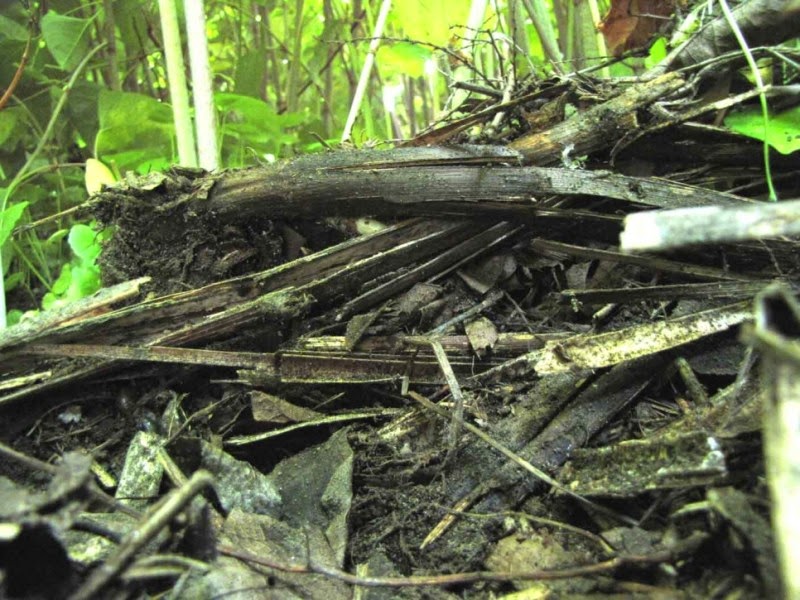
| This layer of decomposing knotweed will eventually form soil organic matter in invaded ecosystems. Credit: Image courtesy of Clemson University |
Since soil stores more carbon than both the atmosphere and terrestrial vegetation combined, the repercussions for how we manage agricultural land and ecosystems to facilitate the storage of carbon could be dramatic.
In their study, Tamura and Tharayil examined the impact of encroachment of Japanese knotweed and kudzu, two of North America's most widespread invasive plants, on the soil carbon storage in native ecosystems.
They found that kudzu invasion released carbon that was stored in native soils, while the carbon amassed in soils invaded by knotweed is more prone to oxidation and is subsequently lost to the atmosphere.
The key seems to be how plant litter chemistry regulates the soil biological activity that facilitates the buildup, composition and stability of carbon-trapping organic matter in soil.
"Our findings highlight the capacity of invasive plants to effect climate change by destabilizing the carbon pool in soil and shows that invasive plants can have profound influence on our understanding to manage land in a way that mitigates carbon emissions," Tharayil said.
Tharayil estimates that kudzu invasion results in the release of 4.8 metric tons of carbon annually, equal to the amount of carbon stored in 11.8 million acres of U.S. forest.
This is the same amount of carbon emitted annually by consuming 540 million gallons of gasoline or burning 5.1 billion pounds of coal.
"Climate change is causing massive range expansion of many exotic and invasive plant species. As the climate warms, kudzu will continue to invade northern ecosystems, and its impact on carbon emissions will grow," Tharayil said.
The findings provide particular insight into agricultural land-management strategies and suggest that it is the chemistry of plant biomass added to soil rather than the total amount of biomass that has the greatest influence on the ability of soil to harbor stable carbon.
"Our study indicates that incorporating legumes such as beans, peas, soybeans, peanuts and lentils that have a higher proportion of nitrogen in its biomass can accelerate the storage of carbon in soils," Tharayil said.
Thrarayil's lab is following up this research to gain a deeper understanding of soil carbon storage and invasion.
Tharayil leads a laboratory and research team at Clemson that studies how the chemical and biological interactions that take place in the plant-soil interface shape plant communities. He is also the director of Clemson's Multi-User Analytical Laboratory, which provides researchers with access to highly specialized laboratory instruments.
Source: Clemson University
Tree diseases can help forests
By UnknownAGRO-ECOLOGY, AGRONOMY, BOTANY, DISEASES, DROUGHT, DROUGHT RESEARCH, EXOTIC SPECIES, FOREST, FRUIT, NATURE, PATHOGEN, PHYTOPATHOLOGY, PLANTS, RAIN FORESTS, SEEDLESS FRUIT, TREES
Plant diseases attack trees and crops and can hurt lumber and food production, but University of Utah biologists found that pathogens that kill tree seedlings actually can make forests more diverse.
While low rainfall has been blamed for a lack of drought-sensitive trees near the Pacific side of the Panama Canal, the new study answers a mystery about what keeps drought-tolerant trees from that area from living along the wetter Caribbean side of the canal. The answer: disease-causing plant pathogens, the researchers report in their study, published online Wednesday, Nov. 12 by the Journal of Ecology.
"Because seedlings of disease-sensitive tree species can't survive in the wetter forests and drought-sensitive tree species cannot survive in the drier forests, different tree species inhabit the wetter and drier forests even though they are only 30 miles apart" in Panama, says Phyllis Coley, a senior author of the study and a distinguished professor of biology.
In other words, tree pathogens contribute to the staggering diversity of trees in Panama's tropical forests, she adds.
The study's first author, biology doctoral student Erin Spear, says that is important because "conservation planning and predictions about how tree species distributions may shift with climate change require an understanding of the factors currently influencing where species can and cannot survive."
That is particularly important in tropical forests and other forests that are under elevated threat of deforestation.
Funding for the study came from Sigma Xi -- The Scientific Research Society, the Smithsonian Institution and the National Science Foundation.
Of Forests and Pathogens
Tropical forests are threatened, and dry tropical forests are even more threatened because sunnier, drier climates are better for growing crops and are favored by people. Some 90 percent of Panama's residents live on the nation's drier Pacific slope.
Forests are essential for feeding and sheltering animals, providing important medicines, storing carbon and water, and reducing erosion by holding soil in place. These functions are influenced by different species inhabiting a forest, so it is essential to understand why certain tree species can survive in certain areas but not others.
Panama's forests also are important economically because tree roots limit how much soil erodes into the Panama Canal, ensuring that huge container ships can pass. Researchers also believe the forests help maintain water levels in the canal because forest soil stores water, slowly releasing it into streams feeding the canal during the dry season.
Diversity is high in tropical forests. A 930-square-mile area bordering the Panama Canal has more than 800 tree species. By comparison, about half the state of Rhode Island -- or some 610 square miles -- is forested, and that area has only 51 tree species.
Part of the reason Panama's forests have more species is because the Pacific end of the canal receives less annual rainfall -- about 5.9 feet -- than the Caribbean end, where 9.8 feet of rain falls annually.
"While there is considerable evidence that less rain in the drier, Pacific forests means that drought-sensitive tree species can't survive there, it has been unclear what prevents the drought-tolerant species of the drier forests from living in the wetter forests," says University of Utah biology professor Tom Kursar, the study's other senior author. "Our study tackled that unanswered question."
So Spear braved mud, rain, insects and snakes to monitor seedlings of a variety of tree species in the wetter and drier forests of central Panama for pathogen-caused damage and death. Plant pathogens that make plants sick include bacteria, viruses and fungi.
Spear says the researchers' findings suggest that "all seedlings are at a greater risk of being injured and killed by pathogens in the wetter forests than in the drier forests." This could be because the damp environment of the wetter forests helps pathogens survive, and more rainfall helps pathogens move from one seedling to another.
But that's only half the story. Coley says that their study indicates "pathogens are implicated in the absence of the dry-forest tree species from the wetter forests, where they might otherwise be able to live. That is because dry-forest tree species are more likely to die from pathogen attack than wet-forest species."
Diagnosing Sick Seedlings
Spear collected the seeds for the study by hiking for miles, kayaking in the canal to collect fruit from overhanging branches, and even riding a crane-carried gondola more than 100 feet upward into the forest canopy.
She conducted the study at two forest sites in central Panama: one at the large Metropolitan Natural Park in Panama City on the drier Pacific side, and one on private property in the Santa Rita Ridge area on the wetter Caribbean side. She planted "gardens" of tree seeds -- including species typical of wetter and drier forests -- in 30 locations at each site. More than 1,000 seeds were planted; 725 of them sprouted.
Once the seeds were planted, the researchers covered them with wire mesh to protect the seeds and seedlings from being crushed by tree branches or eaten by animals.
Spear visited both sites weekly and took notes on the 725 seedlings. Weekly visits were essential because, diseased seedlings can be dead and decomposing within days.
"We monitored when the seeds germinated, the occurrence of and date when symptoms of pathogen attack were observed, if and when a seedling died, and we ascribed a cause of death," Spear says. Pathogen symptoms included patches of black, dead tissue in the leaves or stem. "In some cases, we could actually see the pathogen growing on the seedling," she says.
Of the 725 seedlings that germinated, 38 percent suffered pathogen-caused damage, including 11 percent of seedlings killed by pathogens.
Compared with seedlings in the drier forest, seedlings in the wetter forest were 74 percent more likely to suffer pathogen-caused damage and 65 percent more likely to be killed by pathogens.
"But what was really striking was that pathogen-caused damage was five times more likely to be lethal for seedlings of dry-forest species than for wet-forest species," suggesting dry- and wet-forest species differ in their ability to halt or slow infection, Spear says.
The researchers next plan to identify specific fungi, bacteria and other pathogens and whether they differ in wetter and drier forests.
During her study at the drier park site in Panama City, Spear discussed her research with tourists and other park visitors.
"I'd emerge from the tangles of vines sweaty, muddy and generally disheveled and people couldn't help but ask what I was doing," Spear recalls. "It was heartening to hear how the forest had touched these very different people."
A brief time-lapse video of a seedling dying from pathogen attack during a period of several days can be seen at: http://vimeo.com/58026978 Video by Erin Spear, University of Utah.
Source: University of Utah
"Because seedlings of disease-sensitive tree species can't survive in the wetter forests and drought-sensitive tree species cannot survive in the drier forests, different tree species inhabit the wetter and drier forests even though they are only 30 miles apart" in Panama, says Phyllis Coley, a senior author of the study and a distinguished professor of biology.
In other words, tree pathogens contribute to the staggering diversity of trees in Panama's tropical forests, she adds.
The study's first author, biology doctoral student Erin Spear, says that is important because "conservation planning and predictions about how tree species distributions may shift with climate change require an understanding of the factors currently influencing where species can and cannot survive."
That is particularly important in tropical forests and other forests that are under elevated threat of deforestation.
Funding for the study came from Sigma Xi -- The Scientific Research Society, the Smithsonian Institution and the National Science Foundation.
Of Forests and Pathogens
Tropical forests are threatened, and dry tropical forests are even more threatened because sunnier, drier climates are better for growing crops and are favored by people. Some 90 percent of Panama's residents live on the nation's drier Pacific slope.
Forests are essential for feeding and sheltering animals, providing important medicines, storing carbon and water, and reducing erosion by holding soil in place. These functions are influenced by different species inhabiting a forest, so it is essential to understand why certain tree species can survive in certain areas but not others.
Panama's forests also are important economically because tree roots limit how much soil erodes into the Panama Canal, ensuring that huge container ships can pass. Researchers also believe the forests help maintain water levels in the canal because forest soil stores water, slowly releasing it into streams feeding the canal during the dry season.
Diversity is high in tropical forests. A 930-square-mile area bordering the Panama Canal has more than 800 tree species. By comparison, about half the state of Rhode Island -- or some 610 square miles -- is forested, and that area has only 51 tree species.
Part of the reason Panama's forests have more species is because the Pacific end of the canal receives less annual rainfall -- about 5.9 feet -- than the Caribbean end, where 9.8 feet of rain falls annually.
"While there is considerable evidence that less rain in the drier, Pacific forests means that drought-sensitive tree species can't survive there, it has been unclear what prevents the drought-tolerant species of the drier forests from living in the wetter forests," says University of Utah biology professor Tom Kursar, the study's other senior author. "Our study tackled that unanswered question."
So Spear braved mud, rain, insects and snakes to monitor seedlings of a variety of tree species in the wetter and drier forests of central Panama for pathogen-caused damage and death. Plant pathogens that make plants sick include bacteria, viruses and fungi.
Spear says the researchers' findings suggest that "all seedlings are at a greater risk of being injured and killed by pathogens in the wetter forests than in the drier forests." This could be because the damp environment of the wetter forests helps pathogens survive, and more rainfall helps pathogens move from one seedling to another.
But that's only half the story. Coley says that their study indicates "pathogens are implicated in the absence of the dry-forest tree species from the wetter forests, where they might otherwise be able to live. That is because dry-forest tree species are more likely to die from pathogen attack than wet-forest species."
Diagnosing Sick Seedlings
Spear collected the seeds for the study by hiking for miles, kayaking in the canal to collect fruit from overhanging branches, and even riding a crane-carried gondola more than 100 feet upward into the forest canopy.
She conducted the study at two forest sites in central Panama: one at the large Metropolitan Natural Park in Panama City on the drier Pacific side, and one on private property in the Santa Rita Ridge area on the wetter Caribbean side. She planted "gardens" of tree seeds -- including species typical of wetter and drier forests -- in 30 locations at each site. More than 1,000 seeds were planted; 725 of them sprouted.
Once the seeds were planted, the researchers covered them with wire mesh to protect the seeds and seedlings from being crushed by tree branches or eaten by animals.
Spear visited both sites weekly and took notes on the 725 seedlings. Weekly visits were essential because, diseased seedlings can be dead and decomposing within days.
"We monitored when the seeds germinated, the occurrence of and date when symptoms of pathogen attack were observed, if and when a seedling died, and we ascribed a cause of death," Spear says. Pathogen symptoms included patches of black, dead tissue in the leaves or stem. "In some cases, we could actually see the pathogen growing on the seedling," she says.
Of the 725 seedlings that germinated, 38 percent suffered pathogen-caused damage, including 11 percent of seedlings killed by pathogens.
Compared with seedlings in the drier forest, seedlings in the wetter forest were 74 percent more likely to suffer pathogen-caused damage and 65 percent more likely to be killed by pathogens.
"But what was really striking was that pathogen-caused damage was five times more likely to be lethal for seedlings of dry-forest species than for wet-forest species," suggesting dry- and wet-forest species differ in their ability to halt or slow infection, Spear says.
The researchers next plan to identify specific fungi, bacteria and other pathogens and whether they differ in wetter and drier forests.
During her study at the drier park site in Panama City, Spear discussed her research with tourists and other park visitors.
"I'd emerge from the tangles of vines sweaty, muddy and generally disheveled and people couldn't help but ask what I was doing," Spear recalls. "It was heartening to hear how the forest had touched these very different people."
A brief time-lapse video of a seedling dying from pathogen attack during a period of several days can be seen at: http://vimeo.com/58026978 Video by Erin Spear, University of Utah.
Source: University of Utah
Ancient wisdom boosts sustainability of biotech cotton
By UnknownAGRICULTURAL RESEARCH, AGRICULTURE, AGRICULTURE & FOOD, AGRO-ECOLOGY, AGRONOMY, ARTIFICIAL INTELLIGENCE, COMPUTERS & MATH, GRASSLAND, HEIRLOOM PLANT, LAND MANAGEMENT, NATURAL DISASTER, ORGANIC FARMING
![]() |
| The patchwork of 75 million acres of small farms in northern China includes insecticidal transgenic Bt cotton. Credit: Photo courtesy of Yidong Wu |
Genetically engineered cotton, corn and soybean produce proteins from the widespread soil bacterium Bacillus thuringiensis, or Bt, that kill certain insect pests but are harmless to most other creatures including people. These environmentally friendly toxins have been used by organic growers in sprays for decades and by mainstream farmers in engineered Bt crops since 1996. Planted on a cumulative total of more than half a billion hectares worldwide during the past two decades, Bt crops can reduce use of broadly toxic insecticides and increase farmers' profits. However, rapid evolution of resistance to Bt toxins by some pests has reduced the benefits of this approach.
To delay resistance, farmers plant refuges of insect host plants that do not make Bt toxins, which allows survival of insects that are susceptible to the toxins. When refuges near Bt crops produce many susceptible insects, it reduces the chances that two resistant insects will mate and produce resistant offspring. In the United States, Australia and most other countries, farmers were required to plant refuges of non-Bt cotton near the first type of Bt cotton that was commercialized, which produces one Bt toxin named Cry1Ac. Planting such non-Bt cotton refuges is credited with preventing evolution of resistance to Bt cotton by pink bollworm (Pectinophora gossypiella) in Arizona for more than a decade.
Yet in China, the world's number one cotton producer, refuges of non-Bt cotton have not been required. The Chinese approach relies on the previously untested idea that refuges of non-Bt cotton are not needed there because the most damaging pest, the cotton bollworm (Helicoverpa armigera), feeds on many crops other than cotton that do not make Bt toxins, such as corn, soybean and peanuts. The results reported in the new study provide the first strong evidence that these "natural refuges" of non-Bt crops other than cotton delay evolution of pest resistance to Bt cotton.
Tabashnik used computer simulations to project the consequences of different assumptions about the effects of natural refuges in northern China. The simulations mimic the biology of the cotton bollworm and the planting patterns of the 10 million farmers in northern China from 2010 to 2013, where Bt cotton accounts for 98 percent of all cotton, but cotton represents only 10 percent of the area planted with crops eaten by the cotton bollworm.
"Because nearly all of the cotton is Bt cotton, the simulations without natural refuges predicted that resistant insects would increase from one percent of the population in 2010 to more than 98 percent by 2013," said Tabashnik, who heads the UA's Department of Entomology and also is a member of the UA's BIO5 Institute. "Conversely, resistance barely increased under the most optimistic scenario modeled, where each hectare of the 90 percent natural refuge was equivalent to a hectare of non-Bt cotton refuge."In a third scenario, the researchers used field data on emerging cotton bollworms from different crops to adjust the contribution of each hectare of natural refuge relative to non-Bt cotton. These data were provided by co-author Kongming Wu of the Institute of Plant Protection in Beijing. By this method, the total natural refuge area was equivalent to a 56 percent non-Bt cotton refuge, and 4.9 percent of the insects were predicted to be resistant by 2013.
To distinguish between these possibilities, a team led by co-author Yidong Wu of China's Nanjing Agricultural University tracked resistance from 2010 to 2013 at 17 sites in six provinces of northern China. Insects were collected from the field and more than 70,000 larvae were tested in laboratory feeding experiments to determine if they were resistant. This extensive monitoring showed that the percentage of resistant insects increased from one percent of the population in 2010 to 5.5 percent in 2013.
The field data imply that the natural refuges of non-Bt crops other than cotton delayed resistance with an effect similar to that of a 56 percent non-Bt cotton refuge, just as the model predicted.
"Our results mean we are getting a better understanding of what is going on," Tabashnik said. "We'd like to encourage further documentation work to track these trends. The same kind of analysis could be applied in areas in the U.S. where the natural refuge strategy is used.
"Natural refuges help, but are not a permanent solution," he added. "The paper indicates that if the current trajectory continues, more than half of the cotton bollworm population in northern China will be resistant to Bt cotton in a few years."
To avoid this, the authors recommend switching to cotton that produces two or more Bt toxins and integrating Bt cotton with other control tactics, such as biological control by predators and parasites.
"The most important lesson is that we don't need to choose between biotechnology and traditional agriculture," Tabashnik said. "Instead, we can use the best practices from both approaches to maximize agricultural productivity and sustainability."
Source:University of Arizona
New insights into origins of agriculture could help shape future of food
By UnknownAGRICULTURAL RESEARCH, AGRONOMY, CEREAL, CULTURES, EARLY HUMANS, FLOODS, FOSSILS & RUINS, GRASSLAND, LAND MANAGEMENT, NEANDERTHAL, RESOURCE SHORTAGE, SCIENCE & SOCIETY, TYRANNOSAURUS
Agricultural decisions made by our ancestors more than 10,000 years ago could hold the key to food security in the future, according to new research by the University of Sheffield.
Scientists, looking at why the first arable farmers chose to domesticate some cereal crops and not others, studied those that originated in the Fertile Crescent, an arc of land in western Asia from the Mediterranean Sea to the Persian Gulf.
They grew wild versions of what are now staple foods like wheat and barley along with other grasses from the region to identify the traits that make some plants suitable for agriculture, including how much edible seed the grasses produced and their architecture.
Dr Catherine Preece, who worked on the study with colleagues from the University's Department of Animal and Plant Sciences and Department of Archaeology, said: "Our results surprised us because numerous other grasses that our ancestors ate, but we do not, can produce just as much seed as wild wheat and barley. It is only when these plants are grown at high densities, similar to what we would find in fields, that the advantage of wild wheat and barley is revealed."
The study identified two key characteristics shared by the wild relatives of current crop plants. Firstly they have bigger seeds, which means they grow into bigger seedlings and are able to get more than their fair share of light and nutrients, and secondly, as adult plants they are less bushy than other grasses and package their big seeds onto fewer stems. This means crop wild relatives perform better than the other wild grasses that they are competing with and are better at growing close together in fields, making them ideal for using in agriculture.
"The results are important because our expanding human population is putting increasing demands on food production," said Dr Preece.
"Before humans learnt how to farm, our ancestors ate a much wider variety of grasses. If we can understand what traits have made some grasses into good crops then we can look for those characteristics in other plants and perhaps identify good candidates for future domestication."
She added: "To shape the future we must understand the past, so the more we can discover about the origins of agriculture, the more information we will have to help us tackle the challenges that face modern day food production."
So far the researchers have been conducting their experiments in greenhouses and their results indicate that the traits affecting how plants compete with each other are crucial factors to determining the success of a crop.
The team now plan to observe how the plants interact in their natural environment by growing them in experimental fields in Turkey, the heart of the Fertile Crescent. They hope that their experiments will yield another crop of important results.
"Cereal breeders are taking an increasing interest in modern crops' wild relatives as a source of useful traits that may help to increase yields or increase resilience to climate change, and our work should help in this process," said Dr Preece.
Dr Preece presented the results of this study to the joint British Ecological Society and the French Ecological Society 11 December 2014 in the Grand Palais, Lille.
Source: University of Sheffield
Impact of climate change on the soil ecosystem
By UnknownAGRICULTURAL RESEARCH, AGRICULTURE, AGRONOMY, CLIMATE, ECOLOGY, ECOLOGY RESEARCH, GEOTECHNICAL ENGINEERING, HYDRPHONICS, NATURE, ORGANIC, PLANTS & ANIMALS, RESEARCH, SOIL LIFE, SOIL SCIENCE, SOIL TYPES
The Basque Institute for Agricultural Research and Development NEIKER-Tecnalia has had a Microbial Observatory in the Ordesa and Monte Perdido National Nature Reserve (Huesca Pyrenees) since 2011. Its purpose is to evaluate the impact of climate change on the ecosystems of the soil by monitoring its microbial properties over time. The research areas are located at altitudes of between 1,500 and 2,600 metres, which provides a broad range of different climate conditions and makes it possible to observe how the altitude affects the properties of the soil and the micro-organisms living in it. Preliminary results indicate that microbial properties are highly dependent on the physical and chemical properties of the soil on a small scale and on the environmental conditions existing at the moment when the samples are gathered.
To conduct this research, NEIKER-Tecnalia is using the most advanced techniques in the matter of molecular biology, which have revolutionised microbial ecology. Specifically, massive sequencing analyses are being carried out right now; they allow a large number of genes to be sequenced and identified within a short space of time. The genetic sequencing of the subterranean biosphere is seeking to gain a better understanding of the structure and function of the microbial communities across the altitude gradient.
NEIKER-Tecnalia's Microbial Observatory will contribute towards improving the current understanding of the effects of climate change on soil microbial communities and associated ecological processes. The alpine area where it is located is particularly suitable for a climate change observatory. Firstly, it is a remote spot relatively isolated from direct anthropogenic impacts, which means that global effects like climate change can be clearly perceived without the interference of more local environmental factors. Secondly, the altitude gradients that exist in the mountains in turn create clearly marked climate gradients within short distances; in other words, different climate conditions can be found at different altitudes.
Micro-organisms adapt more quickly than plants and macro-organisms
Micro-organisms adapt more quickly to changes than plants or other macro-organisms, which means they are ideal bioindicators of the impact of sources of environmental stress on the functioning of ecosystems. It is very important to have a record of the alterations gradually occurring in the soil ecosystem as a result of climate change to be able to more accurately predict what future scenarios are going to be in store. It is important to stress that the soil is our most important resource; it is the basis of the terrestrial ecosystem and 95% of our food comes directly or indirectly from it.
The role of micro-organisms in relation to the functioning of the soil ecosystem is fundamental. The soil, which has been traditionally regarded as an inanimate item made up of minerals and chemical substances, contains a myriad of micro-organisms that are responsible for many of its vital functions and, consequently, its health. These functions include the decomposition and recycling of nutrients from dead plant and animal tissue, nitrogen fixing, the maintaining of soil structure and the elimination of contaminants.
It can be predicted that, in the long term, climate change will cause the biota of mountain soil to migrate towards higher altitudes in the quest for the optimum bioclimatic environment. The problem is that this migration has a limit, which is the summit of the mountain, beyond which no migration or escape is possible.
Source: Basque Research
NEIKER-Tecnalia's Microbial Observatory will contribute towards improving the current understanding of the effects of climate change on soil microbial communities and associated ecological processes. The alpine area where it is located is particularly suitable for a climate change observatory. Firstly, it is a remote spot relatively isolated from direct anthropogenic impacts, which means that global effects like climate change can be clearly perceived without the interference of more local environmental factors. Secondly, the altitude gradients that exist in the mountains in turn create clearly marked climate gradients within short distances; in other words, different climate conditions can be found at different altitudes.
Micro-organisms adapt more quickly than plants and macro-organisms
Micro-organisms adapt more quickly to changes than plants or other macro-organisms, which means they are ideal bioindicators of the impact of sources of environmental stress on the functioning of ecosystems. It is very important to have a record of the alterations gradually occurring in the soil ecosystem as a result of climate change to be able to more accurately predict what future scenarios are going to be in store. It is important to stress that the soil is our most important resource; it is the basis of the terrestrial ecosystem and 95% of our food comes directly or indirectly from it.
The role of micro-organisms in relation to the functioning of the soil ecosystem is fundamental. The soil, which has been traditionally regarded as an inanimate item made up of minerals and chemical substances, contains a myriad of micro-organisms that are responsible for many of its vital functions and, consequently, its health. These functions include the decomposition and recycling of nutrients from dead plant and animal tissue, nitrogen fixing, the maintaining of soil structure and the elimination of contaminants.
It can be predicted that, in the long term, climate change will cause the biota of mountain soil to migrate towards higher altitudes in the quest for the optimum bioclimatic environment. The problem is that this migration has a limit, which is the summit of the mountain, beyond which no migration or escape is possible.
Source: Basque Research
Environment Now
Technology+Physics
Health + Medicine
Plants + Animals
SPACE + TIME
Science + Society


Submit your Email Address to Get Free latest Articles Directly to your Inbox


